Exploding bananas, ugly fish, an arsonist's match and preserving Eastern Market
The story of Frontera & Son and how it helped save a beloved Detroit institution, even though it wouldn't be saved itself.

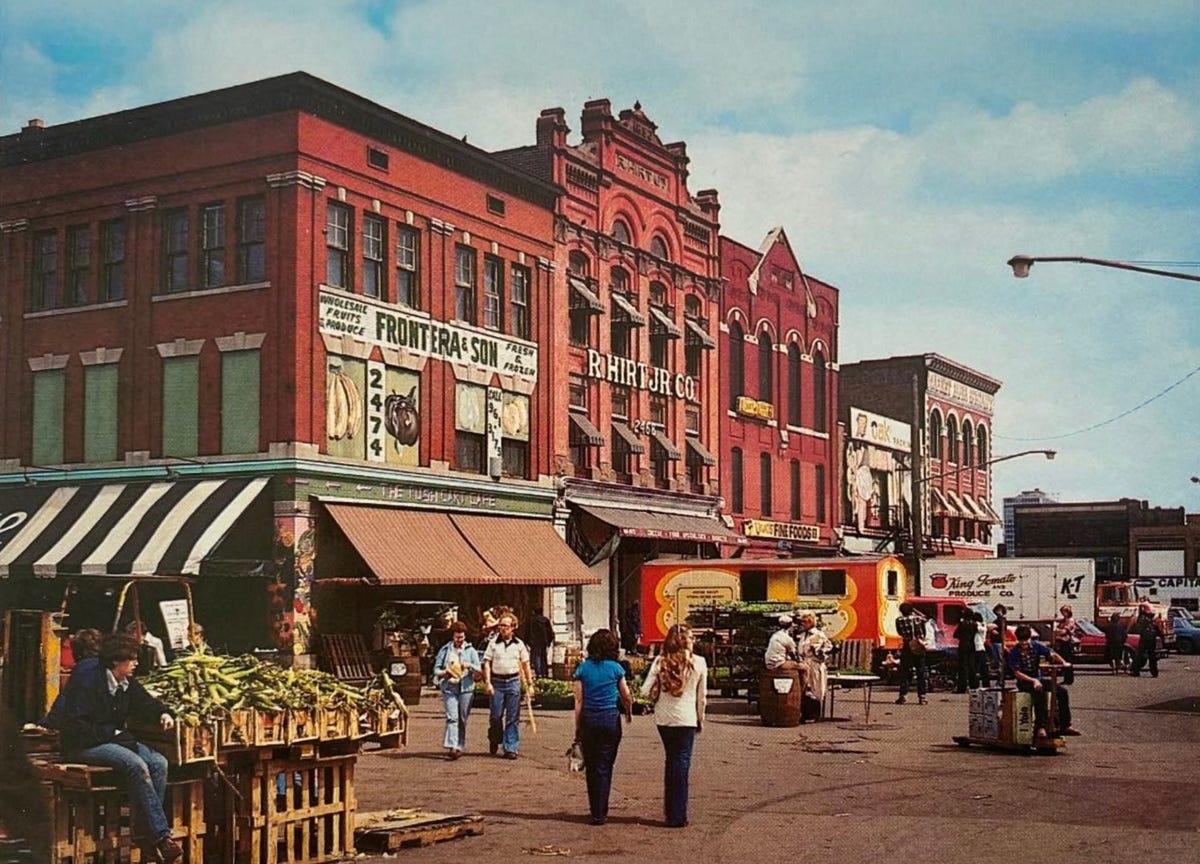
In many ways, Eastern Market feels like it’s never changed, but things weren’t always that way. In fact, it was thanks to the owners of one building in particular that the historic district looks the way it does - even if that building is no longer there to contribute to its beauty and vitality.
The Frontera & Son building managed to survive a pair of explosions tied to ripening bananas, but it couldn’t survive an arsonist. It stood on the corner of Market and Winder streets, opposite Eastern Market’s Shed 1. For most of its life, it was a wholesale grocer, but at the end of it, the building was also home to a bar and restaurant.
It is unknown the exact year that the building was built, however, based on information from Sanborn fire insurance maps and architectural details on the R. Hirt building next door, it is likely that it was built between 1897 and 1904. The year 1903 generates the first “hit” for what is almost assuredly the building in question, a listing for what was then 38-40 Market St. as the home of Lee & Cady, a dry-goods retailer. The 1977 National Register of Historic Places nomination pegs it to “circa 1900,” and notes that “it is probably the last of the buildings … erected along historic Market Street.” Its architect is unknown.
Though simple, it was stately, featuring a brick façade accented by stone lintels and keystones with a dentiled frieze extending below a simple cornice. The property was known for many years as the Roth Building, which may or may not have been the family that built it. It remained under Roth family ownership until about 1947. By the 1910s and 20s, the building housed a wholesale grocer. In the 1930s, the building housed the Central Produce Co.
Absolutely bananas
Around 4:30 a.m. on Sept. 7, 1938, an explosion erupted in the building’s basement when Tony Misuraca, owner of Central Produce, walked into a chamber in the basement that was used for ripening bananas. The cigarette he was smoking ignited gas from a heater that had its flame go out. Misuraca was seriously injured, and two other employees – Vernon Tate, 22, and Robert Daniels, 32 – later died from their injuries. Daniels was the father of three and had been employed at the market for nine years. Tate was the father of two.
“The explosion blasted out a portion of the flooring above the banana-ripening room and bulged the entire floor surface,” The Detroit News wrote the day of the blast. “Windows throughout the building were shattered.”
Central Produce repaired the building, but Misuraca apparently didn’t learn his lesson.
On March 7, 1945 – six-and-a-half years after the explosion - Misuraca was burned again by another explosion at the building. This one also hurt his brother, Frank Misuraca. The men told police they were operating a system for ripening bananas when the explosion occurred. Bananas give off ethylene gas as they ripen, which is flammable, but it’s only in tiny amounts – unless you have an entire basement full of them. This time, the damage appears to have been less severe.
Perhaps having had their fill of exploding bananas, Central Produce gave way shortly after the second blast to Michigan Repack & Produce Co. By the early 1970s, the building was home to Durso Produce.
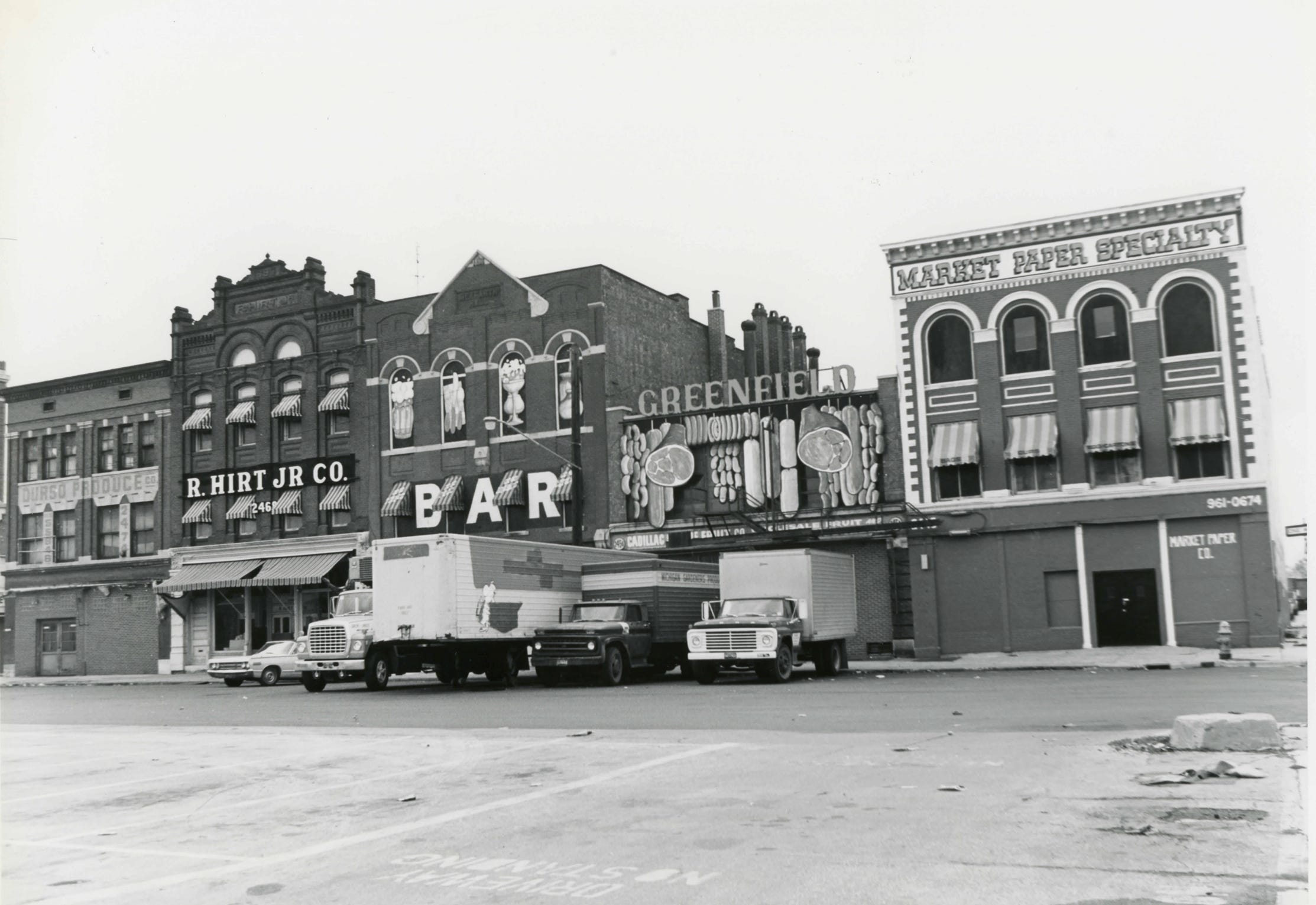
Around 1972, Samuel Frontera opened his Frontera & Son produce distributor in the space, and in 1974, he bought the building. His father began the family produce business by pushing a hand cart from house to house selling fruit and veggies, and young Sam helped. He would spend his entire adult life working in Eastern Market and was a fixture there. He earned the nickname “the orange juice man” by selling fresh-squeezed OJ from a sidewalk stand in front of his store.
In 1977, his son Leo Frontera led an effort to get Eastern Market named to the National Register of Historic Places (NRHP), which made buildings deemed to be contributing to the historic district eligible for tax credits. The Eastern Market Historic District was officially listed Nov. 29, 1978. Of the 225 acres in the NRHP area, 32 received federal historic designation. The Free Press reported Sept. 22, 1980, that of the 120 merchants in the area, more than half were committed to sprucing up their buildings and making the market even more of a destination thanks to the young Frontera’s efforts.
By 1980, the family business was being led by Leo Frontera, then 32 years old, making him the third generation of his family to operate there.
An ugly fish puts the building on the culinary map
The Fronteras opened a restaurant in the back of the building in the mid-1970s called the Push Cart Café, using a separate address in the building of 1488 Winder St. Meanwhile, the family ran the wholesale produce business out of the front.
In April 1977, the Push Cart was making a splash by offering a somewhat unique menu item - “It looks like lobster. And since it also tastes very much like lobster, a finny discovery called ‘monk fish’ all of a sudden has made a quiet little restaurant with a neon-lighted fish tank a place to reckon with,” Free Press food critic “the anonymous gourmet” wrote May 11, 1978. “In its natural state, fresh-caught in the salt waters along the northeastern U.S. coast, the monk fish is ugly as sin, ‘a genuinely terrible-looking creature.’”
Fishermen also call them lophius, toad fish, fishing frogs and sea devils. But the Push Cart Cafe fileted, baked and lightly broiled the tails from these delectable little monsters and made them a popular and far cheaper alternative to lobster.

Not feeling like putting something so terrifying into your mouth? The Push Cart Cafe offered your usual seafood fare - a bucket of steamed clams, for instance. It also had lips smacking over what the anonymous gourmet called “the house’s imaginative creamed spinach-and-asparagus soup,” which “will make believers out of the finicky who said it couldn’t be done.” Most of the menu was supplied fresh thanks to its proximity to the nearby market.
In 1982, the Fronteras closed the Push Cart and leased the restaurant space to Raymond and Debra Mandry, who reopened it as Peg Leg’s. It was apparently home to the best black bean soup in town, “a drive-miles-for-a-bowl” good, the Free Press wrote Dec. 15, 1982. It also served up a great country breakfast on weekends for market shoppers.
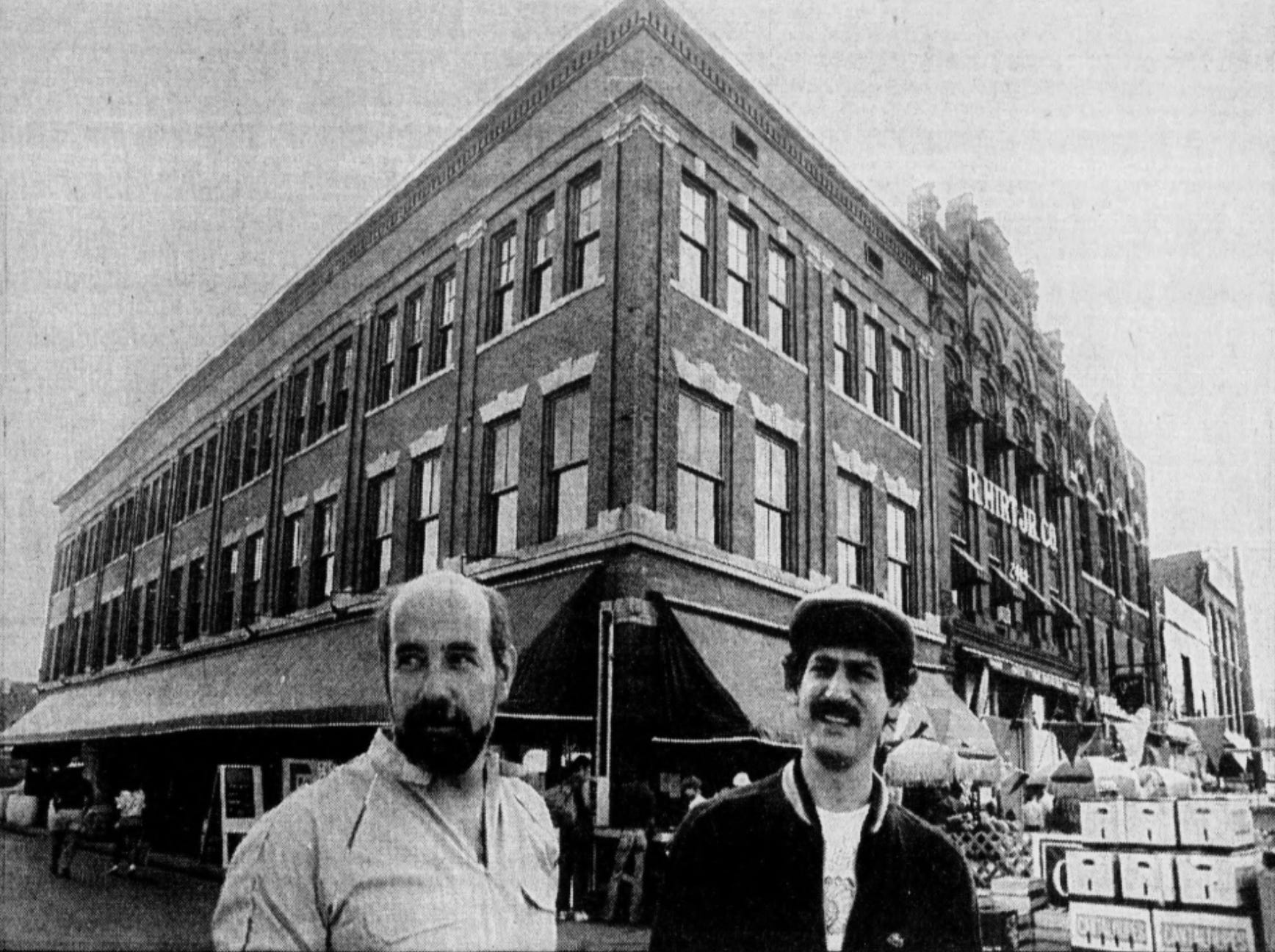
Meanwhile, in 1983, Frontera & Sons was one of the first in Eastern Market to have its original historic character restored thanks to the tax credits enabled by the National Register listing. Mike Johnson, a historic renovation contractor, came up with a plan to convince more building owners to follow suit, and many did. Johnson also sought to turn parking lots in the heart of the market into inviting green spaces and relocate the cars to the market’s periphery, citing the Quincy Market in Boston as a model for Detroit to aspire to.
At Frontera & Son, brick walls were steam-cleaned to remove gaudy paint. Gone were the cinder blocks that did more to keep people out than invite them in, and the brick façade got a deep clean to restore much of its simple but stately glory. Frontera installed large windows where cinder block had been, allowing light to flood into the store -- and so did customers.
“Nobody knew we were here,” he told the Free Press for an Aug. 19, 1983, article on the building’s makeover. “We need to get more people to realize there are shops here.”
Unfortunately, less than two years after the gleaming restoration of the old building, all the Fronteras’ hard work would be lost.
An arsonist finishes what the bananas started
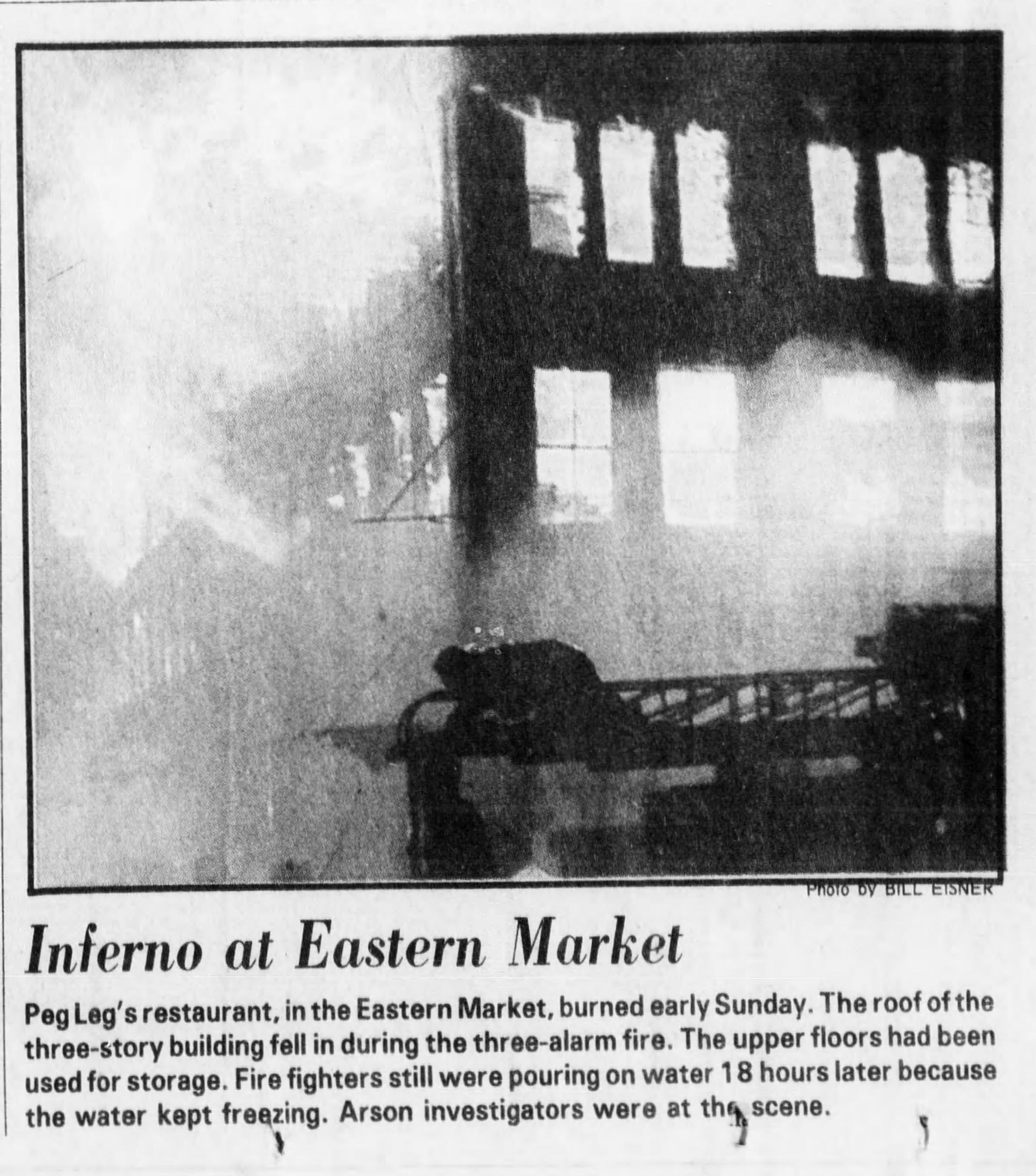
On Jan. 13, 1985, the building was destroyed in a three-alarm fire that resulted in most of the building collapsing, with the Free Press calling the blaze an all-out “inferno.” The roof collapsed, and it took firefighters more than 18 hours to conquer the blaze because the water kept freezing. Damage to the building was estimated at $1 million (about $3 million in 2025).
Fire investigators immediately suspected arson.
For his part, Peg Leg’s owner Ray Mandry told The Detroit News for a Jan. 18, 1985, article: “I’m running around in circles with my head tucked under my arm,” and added that if the Frontera family decided to rebuild, he would open a restaurant there again.
But on March 24, 1985, the Wayne County Prosecutor’s Office announced that it was charging Raymond and Debra Mandry, along with restaurant employee David John Kolasa, with the arson. The trio were accused of burning down the restaurant that they were losing money on to collect on insurance money. Perhaps the Mandrys didn’t mean to destroy the building, but its century-old, heavily lacquered wood caused the fire to get out of hand fast. Each was released on personal bond pending a court hearing that April 3, and faced up to 10 years in prison if convicted. Unfortunately, the newspapers didn’t cover the trial or whether they were acquitted or not, and the state prison system doesn’t keep records for cases this old when the convicted have served their debt to society.
Tragedy would revisit the Fronteras again just seven months later, on Aug. 16, when Samuel Frontera died from a heart attack while making a produce delivery.
But Leo Frontera was undeterred amid the loss, and said he wasn’t giving up on the historic building he and his family had fought so hard to spruce up. On Dec. 4, 1986, almost two years after the fire, he told the City Council that he planned to rebuild two of the three stories, starting the following spring. He cited cost concerns as his reason for not rebuilding all three floors.
However, no work would ever began, and the building was still in ruins on Jan. 14, 1988, three full years after the fire. It’s important to remember that Eastern Market was still a popular and busy shopping district, and the building that had done so much to attract new customers was starting to attract rats instead. In a Jan. 14, 1988, article in The Detroit News marking the third anniversary of the fire – headlined “Eyesore at market” – the newspaper noted that the Fronteras were embroiled in a lawsuit with the Colony Insurance Co. for having not reimbursed them after the fire. Insurance payouts are often crucial for smaller owners to repair or demolish fire-damaged structures. Though the Detroit City Council and nearby store owners wanted the building razed, the Fronteras secured a court order blocking demolition.
However, the building would soon fall, and by May 21, 1991, the site was an empty lot. In 2020, the property was still owned by the Frontera family and being used as a parking lot.
HistoricDetroit.org intern Alexander Grauman of Wayne State University contributed to this report.
Excellent research and history of an Eastern Market institution that was tragically lost. When I researched the Eastern Market district for City of Detroit (local) historic designation, I was shocked that there were many blocks surrounding the sheds that had commercial buildings exactly like the Frontera building. Soooo much has been lost there.