Woulda, coulda, shoulda: The failed opportunity to save Cooley High School
Detroit's most beautiful surviving high school is falling to the wrecking ball. Here's a look at the latest inevitable, avoidable loss of our city's history.

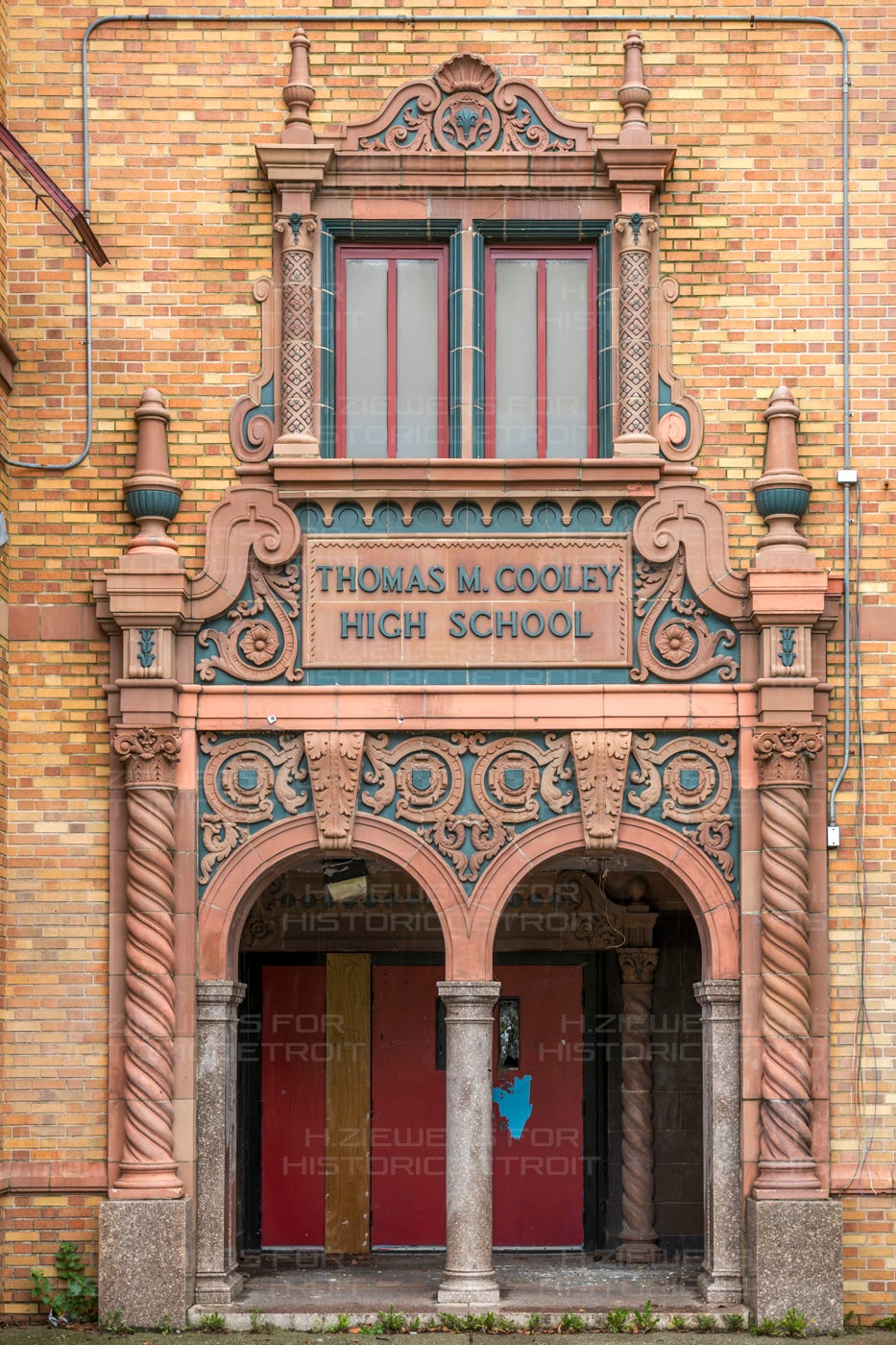
If I’ve learned anything over my decades of documenting Detroit history, one frustratingly contradictory fact has become clear: We are an inherently nostalgic and proud people yet a people hellbent on erasing our past.
From Old City Hall to Tiger Stadium to Boblo Island and the Boblo boats, Black Bottom and Paradise Valley, the list is shockingly and infuriatingly long.
Cooley High School will soon join them in that giant architectural graveyard in the sky.
The many moments to save it have come and gone. But it didn’t have to be this way. I figured I’d take a few minutes to wade into the situation as it is and the arguments made on both sides, and take a look at how this city once again has failed to preserve an architecturally stunning and historically rich piece of Detroit’s past for the future.
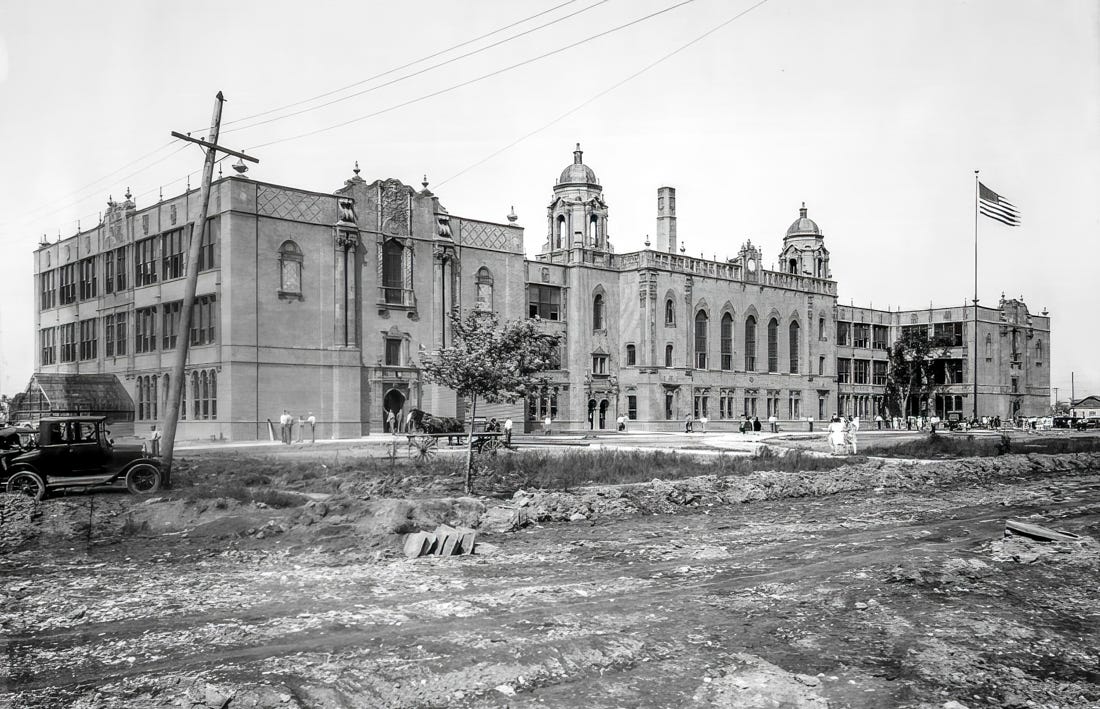
Cooley High School, opened in 1928, was built as a temple of education, a symbol of the value Detroit put into its youth and a place that would inspire them to greatness. Between its intricate terra cotta flourishes and ornate plasterwork inside, it looked like a palace out of Western Europe.
The school was named after former Michigan Supreme Court Chief Justice Thomas McIntyre Cooley (1824-1898). A mural of him in the school library says he was “one who enunciated the principle of law under which it has been possible to have free high schools in this state.”
It was constructed at a cost of $758,270 (the equivalent in purchasing power of about $14.7 million in 2026) to meet the educational needs of a rapidly growing area of the city. At its peak, Cooley had almost 4,000 students in 1949. By 1983, it still had about 3,500 and was one of the largest high schools in Michigan. But by 2010, it had dropped to around 1,000.
The coulda …
Despite its historical significance, despite its proud alumni and pedigree, despite its relative good condition for its age, the Detroit Public Schools closed Cooley in June 2010. The school has remained vacant since.
Now, there is no arguing that the district had too many schools amid dwindling enrollment and shrinking state funding. Many of these schools needed significant investment and improvements because the buildings were old. There was no doubt that many of them needed to be consolidated and shuttered. But surely, Cooley was one of the standout buildings that was worth saving. A more recent addition could have been closed (or demolished) to reduce its footprint and costs. Either way, the boards went up. For years, it remained in good condition, like the district could walk in and reopen it with some elbow grease and a bunch of folks armed with brooms and dustpans.
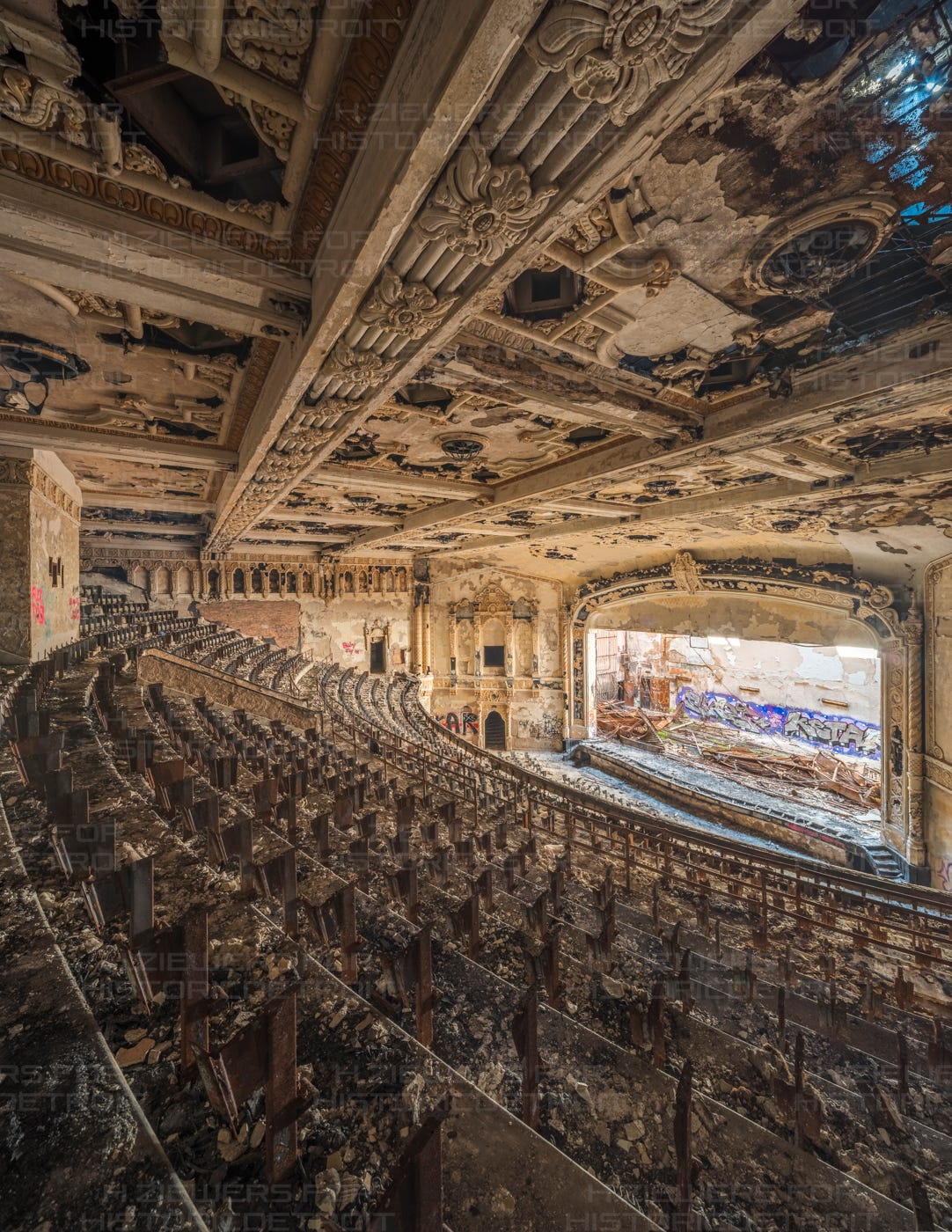
But few buildings make it more than a few years before the scrappers and vandals turn millions in renovation costs into tens of millions. On Oct. 1, 2017, a blaze destroyed much of the auditorium of the abandoned school. This event was the beginning of the inevitable end, but not all hope was lost - yet.
The shoulda …
Despite sitting abandoned for a decade, despite vandals and Mother Nature alike taking a toll on the building, the nonprofit Life Remodeled stepped up and offered to buy the 321,024-square-foot Cooley from the cash-strapped district and turn it into a $40 million community resource hub. The organization had already done something similar with the former Durfee School. After more than three years of negotiations, the group offered $1 million for Cooley. Life Remodeled had a track record of success, but Superintendent Nikolai Vitti and the school board rejected the offer in March 2023 because they said they had doubts about the organization’s ability to raise enough money. Vitti said he believed that if Life Remodeled’s plans didn’t move forward, the district would be held responsible by the community for blight or problems that occurred on the vacant campus. The Detroit Public Schools Community District (DPSCD) has dozens upon dozens of vacant schools in every corner of the city, most of which look far worse on the outside than Cooley.
If Life Remodeled failed and the blame on its shoulders was unfairly directed at the district … what was one the blame for one more school?
So, Cooley would continue to rot, making preservation not only more expensive as time went on, but also more difficult.
DPSCD had already flattened all but a few of Detroit’s palatial historic high schools: Cass Tech, Mackenzie and Mumford were all torn down and replaced with smaller, newer, blander generic boxes. If the belief was that students would learn better in a school just because it was newer, I’d love to see the data. Certainly, fixing up an existing structure is cheaper than the cost of building a new one ground up and spending millions to demolish the old.
It should be noted that finding a new use for a school is not the easiest thing in the world. Sure, classrooms can be the size of studio or one-bedroom apartments, but most of them need to have plumbing and electrical run to them. Far from impossible, but it’s been done in Detroit and many other cities in Michigan and across the country. Many of them are huge, so maybe you take down a wing or two. Large spaces like cafeterias and auditoriums might need to be mothballed or turned into unconventional spaces for a while. Gyms can be used by residents as on-site fitness centers. But again, you can’t do this with ALL of Detroit’s old schools - but you certainly can with the best of the best, schools like Cooley. Life Remodeled’s repurposing of Durfee as a community and innovation center has been wildly praised and - though I don’t have access to the financials - seems to be a success.
The most logical use for an old school is, of course, a school. The district understandably, doesn’t want to hand a competing charter school with a cheap building that will siphon off even more students. We’ve seen the same thing with closed Catholic churches being torn down rather than be sold to other denominations.


The woulda …
Finally, in early May 2025, 15 years after the school’s closure, DPSCD announced a $25 million plan to redevelop the Cooley site into a sports facility for not only the school district, but the community. DPSCD said the new complex would help close the opportunity gap when competing for athletic college scholarships.
The $25 million project had already been allocated $15 million from the State of Michigan, and the school district’s fund-raising arm was working on securing the other $10 million. DPSCD said at the time of the announcement that it would be completed in 2026.
“Ever since Cooley High School closed in 2010, the community has wanted us to do something special with this legendary site,” Superintendent Vitti said in a news release. “We are laser-focused on honoring this commitment with an exciting new complex that builds on Cooley’s legacy and creates equitable sports opportunities for Detroit student athletes and the community.”
Unfortunately, the plan also called for the partial demolition of historic Cooley, BUT the school district promised to save a portion of it. Some Cooley is better than no Cooley. The community and preservation folks all seemed to be ecstatic about the compromise.
“The plan is to preserve a part of the building for the locker room, a museum for the alumni and meeting location,” Chrystal Wilson, a DPSCD spokeswoman, told Crain’s Detroit Business for a May 3, 2025, story on the plan.
But a year later, DPSCD went back on that, confirming news broken by HistoricDetroit.org on May 28, 2026, that the district was abandoning its previously announced plans to save a portion of it.
The decision was tied to a state appropriation of $15 million that had to be spent by the end of that September, and DPSCD planned to use $5 million of that money to demolish the school and salvage architectural elements from it. If the district didn’t tear the school down now, it would lose that state money.
On June 11, 2026, Vitti and Machion Jackson, deputy superintendent of operations, held an online community meeting to explain their decision to go back on their promise of preservation.
“As the architects and the designers better understood the building when they got into it, it was clear to them that if we were going to keep the facade, it would not only increase the cost but also would increase the time line to execute the demo and the construction process, which would have then not have allowed us to use a state grant for $15 million to complete,” Vitti said.
So that leads to the question, if you don’t have time to figure out how to properly save the historic portion of the school like you promised, and the deadline to spend that money hasn’t changed … what on Earth took you so long to get started on implementing the plan. A full year was lost. A year that could have had a plan, if not fully in place, well in place. Yet another wasted opportunity amid a sea of them.


Even before Vitti and Jackson met with the community, architectural salvage began on the school, with crews removing some of the terra cotta starting June 9, 2026. It drove home the point that discussion on saving Cooley is over. It will be demolished, and there is nothing anyone can do to change the district’s mind.
“What we attempted to do was save all of the facade, but based on the time line constraints (to use the state funds for demolition), that was impossible,” Jackson said during the online community meeting.
Added Vitti: “My conscience is clean as a way to preserve the facade and not being able to based on the time line and funding constraints that the district has, but I do commit to all alumni that the legacy of the school will be honored through the athletic complex.”
Detroit-based Hamilton Anderson Architects, an accomplished and much-celebrated Black-owned firm, was selected as lead architect on the Cooley complex project.
And that’s great. But this project could have been so much greater had initiative been taken earlier. No one, not even this building-hugger, was expecting the school to ever be restored and used as a school again. But did the promise of preserving a portion of this irreplaceable piece of Detroit architecture get my hopes up? Yeah, it did. It made me think that folks had seen the wisdom and value of preservation and thinking beyond wrecking balls and bulldozers and generic plasticine-looking structures.
Instead, it’s a reminder to not get your hopes up beyond downtown, that complacency and lack of urgency remains abundant, and that in Detroit - with all of its commercial real estate and population, financial and geographical challenges - believe it only when you see it.
This reminds of the story of the expansion of the University of Michigan hospital complex. The plan was to save the main entrance of Old Main. Psych!